

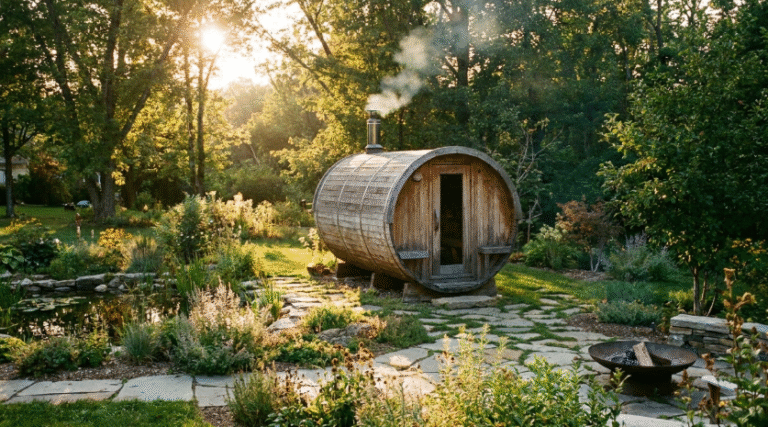
A barrel sauna needs a level, well-drained surface that keeps its cradle off standing water, and the three most common choices are a compacted gravel pad, concrete deck blocks or pavers, and an existing wood deck rated for the added weight. None require a poured concrete slab. In a small yard, a 4 to 6 inch gravel base roughly matching the barrel’s footprint, tucked against a fence line or garage wall, is usually the fastest and cheapest option that still holds up for years.
Why the Base Matters as Much as the Barrel Itself
A curved barrel sauna rests on a steel or timber cradle running the length of its underside, and that cradle needs even contact across its whole length or the barrel can rock, twist slightly, or develop gaps between staves over time. Grass or bare dirt is the worst option: it holds moisture against the cradle, shifts with frost heave in colder regions, and turns uneven within a season as the ground settles unevenly under a load of 1,500 pounds or more. Getting the base right the first time avoids a barrel that never quite sits flat, which stresses the tongue-and-groove staves and can eventually let in drafts.
Concrete Pavers and Deck Blocks: The Simplest Option
For a small side yard or a corner between a fence and the house, a row of concrete deck blocks or paving stones set on leveled, compacted soil is often the quickest path to a stable base. This works well specifically because a barrel’s cradle distributes weight along a few contact points rather than one continuous footprint, so blocks spaced under those load points, checked with a level before final placement, support the barrel without a full pad underneath. This option also suits a rented property or a spot where a future move is possible, since blocks lift out cleanly.
Gravel Pads: What Depth and Base Do You Actually Need
A proper gravel pad starts with excavating a few inches of topsoil, then compacting 4 to 6 inches of crushed gravel (three-quarter inch minus works well) in the barrel’s footprint, plus a foot or two of margin on each side. A thin top layer of fine gravel or leveling sand, screeded flat, gives the cradle a smooth surface to sit on and lets rain drain straight through instead of pooling under the barrel the way it would on packed dirt. This is the option most buyers with a compact yard settle on when comparing setups like the SaunaLife E8 line, since it sheds the rain runoff that a rounded roof directs straight down the sides without needing a full deck build.
Building on an Existing Deck: What to Check First
Placing a barrel sauna on an existing wood deck can work, but it is worth confirming the deck’s joists and footings before committing, since a fully assembled 6-person barrel with a heater and water bucket can weigh 1,500 to 2,500 pounds concentrated over a relatively small footprint. Joist spacing, footing depth, and whether the deck was built to a load rating beyond simple foot traffic all matter here. A contractor or structural check before installation is worth the modest cost, especially compared with the cost of a sagging deck section discovered after the barrel is already in place. Retailers like SweatDecks the SaunaLife E8 list the shipped weight on the product page, which is a useful number to hand a contractor when asking about deck load capacity.
Why a Stable Base Supports Consistent Use
The research behind regular sauna use, including a 2018 review in Mayo Clinic Proceedings and a systematic review in Evidence-Based Complementary and Alternative Medicine, is built on cohorts using saunas consistently over months and years, not occasionally. That consistency is easier to sustain when the barrel itself is not a hassle to use, and a base that shifts, pools water, or leaves the door dragging on an uneven sill is a small but real reason people stop using a sauna they otherwise enjoy. A stable, well-drained base is a practical decision, not a cosmetic one, and it is worth the extra weekend of prep work before the barrel arrives.
Directing Rain Runoff Away From a Curved Roof
A barrel’s rounded roof is one of its most useful design features for shedding weather, but it also concentrates runoff along two lines running the full length of the barrel rather than spreading it evenly the way a flat or gently pitched roof would. Water that funnels off both sides during a heavy rain needs somewhere to go, so a base that slopes gently away from the barrel on both long sides, even a half-inch of fall per foot, keeps that runoff moving instead of pooling right where the cradle meets the ground. Gravel handles this naturally, since water drains straight through rather than sheeting off the way it would on a paver surface without a planned slope.
This detail matters more in a small yard than a large one, since a tight side-yard placement often means the runoff has less open ground to disperse into and is more likely to end up against a fence, a foundation wall, or a neighboring structure. A small gravel apron extending a foot or two beyond the barrel’s roofline on the runoff side gives that water somewhere to land and drain without eroding a bare patch of soil or, worse, working its way toward a nearby wall over repeated storms.
How Uneven Ground Affects the Door and Bench Over Time
A barrel that starts out level but sits on a base that settles unevenly over a year or two develops problems slowly rather than all at once. The door frame can shift enough that it no longer closes flush, letting a thin but constant draft into the cabin that makes the heater work harder without an obvious cause. Bench supports, which run along the cradle’s length, can also develop a slight lean that is barely noticeable to sit on but is enough to change how water pools if any gets tracked in. Checking the barrel’s level with a simple carpenter’s level once a year, ideally each spring after winter frost has had a chance to shift the ground, catches this kind of drift early, before it turns into a bigger repair.
Frequently Asked Questions
Can a barrel sauna sit directly on grass or dirt? Not for long. Bare grass or dirt holds moisture against the base, speeding up rot and creating an uneven surface that shifts over a season.
How deep should a gravel pad be for a barrel sauna? A compacted base of 4 to 6 inches of crushed gravel, topped with an inch of leveling sand, is a common standard for drainage and stability.
Does a barrel sauna need a concrete slab? No. Concrete deck blocks, pavers, or a compacted gravel pad are all commonly used and code-acceptable alternatives to a poured slab.
Can a barrel sauna go on an existing wood deck? Often yes, provided the joists and footings can support the added weight, which can run 1,500 to 2,500 pounds for a 6-person unit.
References
- Benefits and risks of sauna bathing, The American Journal of Medicine, 2001
- Does the Combination of Finnish Sauna Bathing and Other Lifestyle Factors Confer Additional Health Benefits? A Review of the Evidence, Mayo Clinic Proceedings, 2023
- Effects of heat and cold on health, with special reference to Finnish sauna bathing, American Journal of Physiology, 2018
By Colin Marsh